Note : This is an unofficial site meant for exchange of information between the students of IIT only.

Thursday, May 21, 2009

How RNA got started

Scientists may have figured out the chemistry that sparked the beginning of life on Earth.

The new findings map out a series of simple, efficient chemical reactions that could have formed molecules of RNA, a close cousin of DNA, from the basic materials available more than 3.85 billion years ago, researchers report online May 13 in Nature.
“This is a very impressive piece of work — a really excellent analysis,” comments chemist James Ferris of the Rensselaer Polytechnic Institute in Troy, N.Y.

The new research lends support to the idea that RNA-based life-forms were the first step toward the evolution of modern life. Called the RNA world hypothesis, the idea was first proposed some 40 years ago. But until now, scientists couldn’t figure out the chemical reactions that created the earliest RNA molecules.

Today, DNA encodes the genetic blueprint for life — excluding some viruses, for those who consider viruses living — and RNA acts as an intermediary in the process, making protein from DNA. But most scientists think it’s unlikely that DNA was the basis of the origin of life, says study coauthor John Sutherland of the University of Manchester in England.

Information-bearing DNA holds the code needed to put proteins together, but at the same time, proteins catalyze the reactions that produce DNA. It’s a chicken-or-egg problem. Scientists don’t think that DNA and proteins could have come about independently — regardless of which came first — and yet still work together in this way.

It’s more plausible that the first life-forms were based on a single molecule that could replicate itself and store genetic information — a molecule such as RNA (SN: 4/7/01, p. 212). RNA world proponents speculate modern DNA and proteins evolved from this RNA-dominated early life, and RNA in cells today is left over from this early time.

While reactions to make RNA from ancient precursors worked on paper, the chemistry didn’t work in the lab. And some scientists thought even RNA molecules were too complex to have spontaneously formed in the primordial soup. Sutherland and his colleagues have shown the reactions are possible.

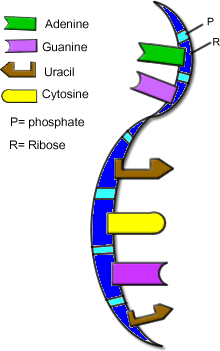
RNA molecules are formed from three components: a sugar, a base and a phosphate group. In past research, chemists developed each of the components and then tried to put them together to make the complete molecule. “But the components are quite stable, and so they wouldn’t stick together,” Sutherland says. “After 40 years of trying, we decided there had to be a better way of doing this reaction.”

The team took a different approach, starting with a common precursor molecule that had a bit of the sugar and the base. “Basically, we took half a base, added that to half a sugar, added the other piece of base, and so on,” Sutherland says. “The key turned out to be the order that the ingredients are added and the way you put them together — like making a soufflĂ©.”

Another difference is that Sutherland and his team added the phosphate to the mix earlier than in past experiments. Having the phosphate around so early helped the later stages of the reaction happen more quickly and efficiently, the scientists say.

The starting materials and the conditions of the reaction are consistent with models of the geochemistry of an early Earth, the team says.

“But while this is a step forward, it’s not the whole picture,” Ferris points out. “It’s not as simple as putting compounds in a beaker and mixing it up. It’s a series of steps. You still have to stop and purify and then do the next step, and that probably didn’t happen in the ancient world.”

Sutherland and his team can so far make RNA molecules with two different bases, and there are still another two bases to figure out. “It’s related chemistry,” Sutherland says. “That’s how it must have been in the very beginning — a series of fundamental reactions that could make all four types of RNA molecule.”

Once those RNA molecules formed, they would have had to string together to make multiple letters of the code, which could then make proteins. Proteins could then make all the components that make up a cell, and the process would continue from there.

Saturday, April 25, 2009

Researchers Reveal Complete Genetic Sequence of Cow

By Jessica Berman, Washington, 24 April, 2009


An international consortium of researchers has completed mapping the genetic blueprint of the domestic cow, a source of nutrition and livelihood for billions of people around the world. Scientists say the landmark accomplishment will lead to better food production and improvements in human medicine.
The completed bovine genome map is the first full sequencing of a mammalian livestock species. It provides new insight into what makes a cow a cow and identifies important genetic traits that distinguish it from humans and other mammals.
The map, published Friday in the journal Science, is the fruit of a six-year international research effort called the Bovine Genome Sequencing and Analysis Project. The consortium of 300 international scientists mapped the nearly 22,000 genes, or hereditary building blocks, of a Hereford cow - a beef-producing ruminant in wide use around the world.
Scientists compared the cow genome to that of seven other mammals - including the human, dog, rat, mouse, opossum and platypus - and found they share a core set of more than 14,000 genes.
Humans share 80 percent of their genetic sequence with cows, according to the scientists, who say we're more closely related to bovines than to rats and mice.
Researcher Kim Worley at the Baylor College of Medicine in Houston, Texas, which spearheaded the research, says the completed map of the cow genome has implications for laboratory research into new drugs.
"What that means is that when we want to study something that's a human protein we might get better information by studying it in cattle than in mice and rats," Worley said.
Jane Peterson of the Human Genome Project at the US National Institutes of Health, which helped fund the consortium's research, says the cow has been a model for studying human hormone disorders. She says having the entire gene sequence available for study makes the cow a more useful research tool.
"Bovine insulin, for example, was used to find the composition of insulin. And it's also been a model for studying many of the endocrine diseases and the conditions in female cows that are directly related to human[s]," she said.
Cracking the bovine genetic code will also make it a lot simpler and cheaper for cattle breeders to enhance the desirable traits in cattle to produce higher-quality milk and meat, according to geneticist Curt Van Tassell, with the U.S. Department of Agriculture in Beltsville, Maryland.
Van Tassel led a team comparing the bovine sequence in the Hereford cow to six other breeds of cattle, studying important variations, and focusing on the special genes governing cattle reproduction, digestion, lactation and disease resistance.
He says breeders will no longer have to wait years for a bull to produce offspring to learn whether they have desirable genes.
"Specifically what we're able to do is generate a genetic value for a bull the day he's born essentially ... that replaces a process that took six to seven years and $25,000 to $50,000 by collecting performance data on daughters," he said.
A commentary in Science magazine hails the landmark genetics work, predicting that the bovine genetic roadmap may lead to many other important spin-offs.

Wednesday, April 15, 2009

bel302

Prof Narang has asked us to submit the assignment by monday.
The chapter is available at scoops.

Minor 2 copies r checked so contact Prof Gomes. He will show d copies in a day or 2

Wednesday, April 8, 2009

Open House

Mail by Dr. D Sundar :

Dear All,

As you may be aware, the IIT-D 'Open House' is scheduled for April 18
(saturday). I would be coordinating the activities for our Department and
would like to have some of you as Activity Heads/Volunteers. It is a day
long affair from 9-5 pm.

Please pass on this message to your other batchmates and seniors/juniors
who may be interested. I look forward to active partcipation from your
side.

Regards,
-Sundar

Monday, April 6, 2009

Gene Expression

Evolution in a bottle


One of the most important experiments in evolution is going on right now in a laboratory in Michigan State University. A dozen flasks full of E. coli are sloshing around on a gently rocking table. The bacteria in those flasks has been evolving since 1988--for over 44,000 generations. And because they've been so carefully observed all that time, they've revealed some important lessons about how evolution works.
The experiment was launched by MSU biologist Richard Lenski. I wrote about Lenski's work last year in the New York Times, and in more detail my new book Microcosm. Lenski started off with a single microbe. It divided a few times into identical clones, from which Lenski started 12 colonies. He kept each of these 12 lines in its own flask. Each day he and his colleagues provided the bacteria with a little glucose, which was gobbled up by the afternoon. The next morning, the scientists took a small sample from each flask and put it in a new one with fresh glucose. And on and on and on, for 20 years and running.


Based on what scientists already knew about evolution, Lenski expected that the bacteria would experience natural selection in their new environment. In each generation, some of the microbes would mutate. Most of the mutations would be harmful, killing the bacteria or making them grow more slowly. Others would be beneficial allowing them to breed faster in their new environment. They would gradually dominate the population, only to be replaced when a new mutation arose to produce an even fitter sort of microbe.
Lenski used a simple but elegant method to find out if this would happen. He froze some of the original bacteria in each line, and then froze bacteria every 500 generations. Whenever he was so inclined, he could go back into this fossil record and thaw out some bacteria, bringing them back to life. By putting the newest bacteria in his lines in a flask along with their ancestors, for example, he could compare how well the bacteria had adapted to the environment he had created.
Over the generations, in fits and starts, the bacteria did indeed evolve into faster breeders. The bacteria in the flasks today breed 75% faster on average than their original ancestor. Lenski and his colleagues have pinpointed some of the genes that have evolved along the way; in some cases, for example, the same gene has changed in almost every line, but it has mutated in a different spot in each case. Lenski and his colleagues have also shown how natural selection has demanded trade-offs from the bacteria; while they grow faster on a meager diet of glucose, they've gotten worse at feeding on some other kinds of sugars.
Last year Lenski was elected to the National Academy of Sciences. This week he is publishing an inaugural paper in the Proceedings of the National Academy of Sciences with his student Zachary Blount and postdoc Christina Borland. Lenski told me about the discovery behind the paper when I first met him a few years ago. He was clearly excited, but he wasn't ready to go public. There were still a lot of tests to run to understand exactly what had happened to the bacteria.
Now they're sure. Out of the blue, their bacteria had abandoned Lenski's their glucose-only diet and had evolved a new way to eat.
After 33,127 generations Lenski and his students noticed something strange in one of the colonies. The flask started to turn cloudy. This happens sometimes when contaminating bacteria slip into a flask and start feeding on a compound in the broth known as citrate. Citrate is made up of carbon, hydrogen, and oxygen; it's essentially the same as the citric acid that makes lemons tart. Our own cells produce citrate in the long chain of chemical reactions that lets us draw energy from food. Many species of bacteria can eat citrate, but in an oxygen-rich environment like Lenski's lab, E. coli can't. The problem is that the bacteria can't pull the molecule in through their membranes. In fact, their failure has long been one of the defining hallmarks of E. coli as a species.
If citrate-eating bacteria invade the flasks, however, they can feast on the abundant citrate, and their exploding population turns the flask cloudy. This has only happened rarely in Lenski's experiment, and when it does, he and his colleagues throw out the flask and start the line again from its most recently frozen ancestors.
But in one remarkable case, however, they discovered that a flask had turned cloudy without any contamination. It was E. coli chowing down on the citrate. The researchers found that when they put the bacteria in pure citrate, the microbes could thrive on it as their sole source of carbon.
In nature, there have been a few reports of E. coli that can feed on citrate. But these oddballs all acquired a ring of DNA called a plasmid from some other species of bacteria. Lenski selected a strain of E. coli for his experiments that doesn't have any plasmids, there were no other bacteria in the experiment, and the evolved bacteria remain plasmid-free. So the only explanation was that this one line of E. coli had evolved the ability to eat citrate on its own.
Blount took on the job of figuring out what happened. He first tried to figure out when it happened. He went back through the ancestral stocks to see if they included any citrate-eaters. For the first 31,000 generations, he could find none. Then, in generation 31,500, they made up 0.5% of the population. Their population rose to 19% in the next 1000 generations, but then they nearly vanished at generation 33,000. But in the next 120 generations or so, the citrate-eaters went berserk, coming to dominate the population.
This rise and fall and rise suggests that the evolution of citrate-eating was not a one-mutation affair. The first mutation (or mutations) allowed the bacteria to eat citrate, but they were outcompeted by some glucose-eating mutants that still had the upper hand. Only after they mutated further did their citrate-eating become a recipe for success.
The scientists wondered if other lines of E. coli carried some of these invisible populations of weak citrate-eaters. They didn't. This was quite remarkable. As I said earlier, Lenski's research has shown that in many ways, evolution is repeatable. The 12 lines tend to evolve in the same direction. (They even tend to get plump, for reasons yet to be understood.) Often these parallel changes are the result of changes to the same genes. And yet when it comes to citrate-eating, evolution seems to have produced a fluke.
To gauge the flukiness of the citrate-eaters, Blount and Lenski replayed evolution. They grew new populations from 12 time points in the 33,000-generations of pre-citrate-eating bacteria. They let the bacteria evolve for thousands of generations, monitoring them for any signs of citrate-eating. They then transferred the bacteria to Petri dishes with nothing but citrate to eat. All told, they tested 40 trillion cells. Here's a movie of what that looks like...

Out of that staggering hoard of bacteria, only a handful of citrate-eating mutants arose. None of the original ancestors or early predecessors gave rise to citrate-eaters; only later stages in the line could--mostly from 27,000 generations or beyond. Still, even among these later E. coli, the odds of evolving into a citrate-eater was staggeringly low, on the order of one-in-a-trillion.
Now the scientists must determine the precise genetic steps these bacteria took to evolve from glucose-eaters to citrate-eaters. In order to eat a particular molecule, E. coli needs a special channel in its membranes through which to draw it. It's possible, for example, that a channel dedicated to some other molecule mutated into a form that could also take in citrate. Later mutations could have fine-tuned it so that it could suck in citrate quickly.
If E. coli is defined as a species that can't eat citrate, does that mean that Lenski's team has witnessed the origin of a new species? The question is actually murkier than it seems, because the traditional concept of species doesn't fit bacteria very comfortably. (For the details, check out my new article on Scientific American, "What is a Species?") In nature, E. coli swaps lots of genes with other species. In just the past 15 years or so, for example, one disease-causing strain of E. coli acquired hundreds of genes not found in closely related E. coli strains. (See my recent article in Slate.) Another hallmark of E. coli is its ability to break down lactose, the sugar in milk. But several strains have lost the ability to break it down. (In fact, these strains were originally given a different name--Shigella--until scientists realized that they were just weird strains of E. coli.)
Nevertheless, Lenski and his colleagues have witnessed a significant change. And their new paper makes clear that just because the odds of such a significant change are incredibly rare doesn't mean that it can't happen. Natural selection, in fact, ensures that sometimes it does. And, finally, it demonstrates that after twenty years, Lenski's invisible dynasty still has some surprises in store.
Source: Z.D. Blount, C.Z. Borland, and R.E. Lenski, "HI istorical Contigency and the Evolution of a Key Innovation in an Experimental Population of Escherichia coli." PNAS in press (http://www.pnas.org/cgi/doi/10.1073/pnas.0803151105) [UPDATE: PDF AVAILABLE ON LENSKI'S SITE.]

Friday, April 3, 2009

change of slots

hey we r doing a course bel301 in c slot
plz check d possibility of replacing to h slot,,
we can get gud oc in c slot